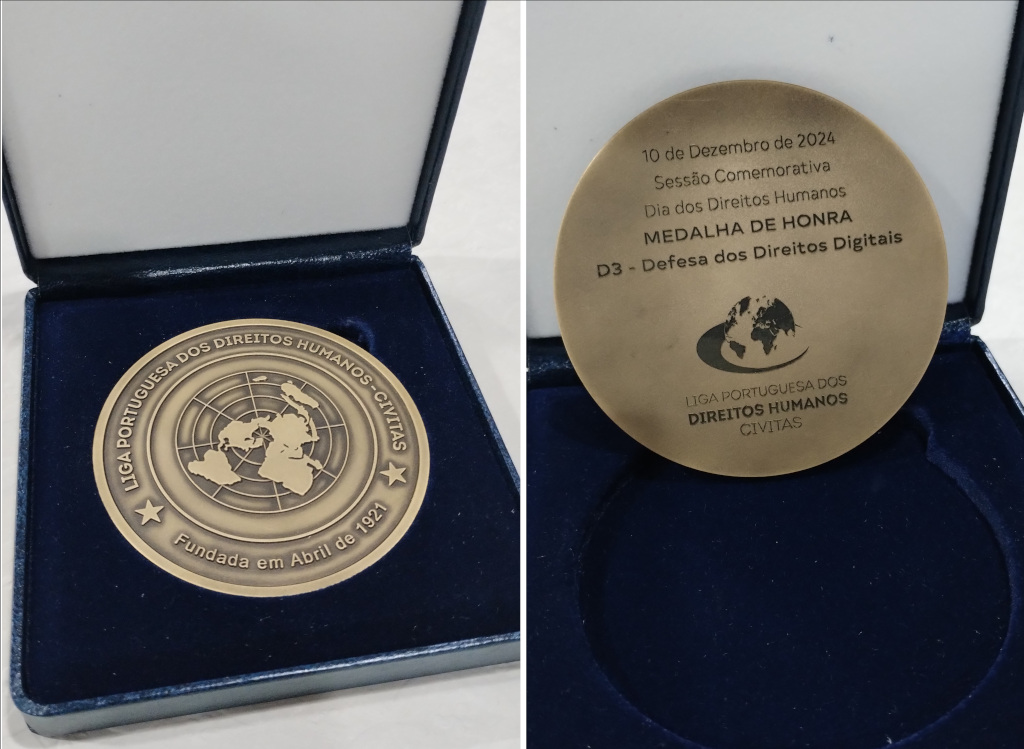
D3 awarded the Medal of Honour from the Portuguese Human Rights League – Civitas

(This happened some months ago, but I'm a bit late in my blog posts).
I'm incredibly proud that D3 was awarded the Medal of Honour from the Portuguese Human Rights League – Civitas! Even now, after some time, it feels a bit surreal :)
This distinction is given at most once a year, in recognition of individuals and institutions whose work makes an exceptional contribution to the promotion and defense of human rights and human dignity.
I had the honour of representing D3 at the award ceremony, which was held on December 10 — Human Rights Day — at the Casa das Histórias Paula Rego in Cascais.
To the Portuguese Human Rights League – Civitas: Thank You for this meaningful recognition.
Below, you'll find a machine-translation of the acceptance speech notes.
Notes from the acceptance speech (adapted)
Dear Portuguese Human Rights League - Civitas (LPDHC), its Board and President, dear speakers, and all those present.
It is a pleasure and an honour to be here today on behalf of D3, its Board of Directors, and in particular its President, Ricardo Lafuente, who was here yesterday from Porto to present a keynote as part of the Digital Rights Festival - an event co-organised by the LPDHC. Unfortunately, due to family and professional commitments, he can't be here today. My name is Eduardo Santos, I'm one of the founders of D3, and I was its President between 2017 and 2023.
I would like to thank the Portuguese Human Rights League - Civitas, in the person of its President, Dr Paulo Sargento, for such an honourable distinction.
Digital rights
What is this about "digital rights" anyway? Today, at this ceremony, we are celebrating International Human Rights Day. Are they the same thing? Something similar, something different?
At D3 we define digital rights as fundamental rights in a technological context, especially when related to the Internet. Academic categorisations and definitions are less interesting to us, we leave that to the academic theorists. In any case, the autonomisation of digital rights, or at least of digital rights groups or movements, arose for historical reasons, of a practical nature, with the most relevant antecedents of this movement dating back to the 1980s and 1990s. In Europe, EDRi - European Digital Rights - was founded in 2002, of which D3 is the only Portuguese member.
It was becoming clear around this time, at least to certain groups more closely linked to technology, that there were fundamental questions to be answered relating to the impact of technology on our lives and our rights. It was a relatively new area, not usually covered or addressed by traditional human rights organisations, and so digital rights groups developed autonomously. At its root was the urgent need to develop capable and informed critical thinking about technology. At its genesis, the digital rights movement combines the technological expertise of hackers - in the original sense of the term - with an uncompromising defence of human rights in the digital world.
Today, there is less and less separation between digital rights movements and other human rights movements. Today, the importance of technology in our lives has become so evident that I don't even need to elaborate on this point. I therefore believe that the future will be one of convergence. After all, digital rights are human rights; human rights are also digital.
About D3
D3 began sometime in 2016, after an initial public call for its creation and some subsequent online preparation. This was followed by a constituent meeting in Porto, and the first general assembly in Lisbon in 2017, where 15 people, most of whom hadn't met before, became founding members of the association. D3 currently has around 70 members. The most predominant profile is technical, the result of a strong connection to the free software movement.
I would briefly highlight three examples of our activity.
Firstly, the declaration of the unconstitutionality of the metadata law by the Constitutional Court, following a complaint we lodged with the Ombudsman in 2017 - one of our first initiatives, which took several years to bear fruit.
During the pandemic we were also very active with contact tracing apps, a by-product of the prevailing technological solutionism, which presented more problems than advantages. Especially since the government announced that their use would be compulsory for civil servants and military personnel - a measure it quickly abandoned.
More recently, the Social Internet Tariff, which we quickly realised was problematic and campaigned and lobbied for, but only partially succeeded in improving. The future has proved us right: of the lofty goal of reaching 800,000 families in need, only 500 have signed up. Not 500,000. 500. It was that fantastic.
The defence of digital rights
Dear friends, the defence of human rights in digital does not make us many friends. It's often seen as inconvenient, controversial and therefore poorly received:
Be it when I had to listen to the Honourable Director of the National Criminal Investigation Police (PJ) say publicly, in a Jornal de Notícias podcast, that he hoped I would never need the help of the PJ, as a victim, because of my opinion on the subject of metadata. A complex subject, but where our opinion is the same as that of the Constitutional Court, the EU Court of Justice, the Ombudsman and the National Data Protection Commission.
Whether it's when we tackle the issue of telecoms encryption and have to deal with that populist-security discourse that we want to protect criminals.
Similarly, when we criticise the unstoppable expansion of video surveillance in public spaces, without any proportionality criteria, in a country that is one of the safest in the world.
Whether it's when we criticise the capture by the big tech companies of the state's entire digital infrastructure, and some consider us as anti-innovation or anti-market.
Whether it's when we criticise issues such as the Social Internet Tariff and some assume party-political motivations from us, when the failure of the measure, because it is terrible at every level, was all too evident, predictable and expected.
Whether it's when we criticise zero-rating tariffs and the chronic inaction of ANACOM and governments, which have allowed our telecommunications market, one of the most expensive in Europe, to be captured by an oligopoly.
Or when we criticise the ideas of moving forward with electronic voting, which is far too insecure and a serious danger to democracy, in the face of those who only value mere convenience.
So...
As you can see, defending digital rights, like human rights, isn't easy, doesn't win favours and isn't without controversy. But if it were easy, we wouldn't be here. We're doing this fight because it has to be done.
That's why we're very honoured by this unexpected distinction.
Ladies and gentlemen, as has already been mentioned, authoritarianism is on the prowl, and worse, it's fashionable. Even if some of it is only performative, we also have the real thing, a real threat to our democracy. That's why the defence of human rights is essential today, and it too must come back into fashion.
Conclusion
I often say that associations don't exist. They don't do anything. They are a mere legal fiction, a name and a number inserted somewhere in a public register. Some may have more visible assets, such as a head office, but not all of us. Our 70 or so members pay an ordinary membership fee of €32 a year, which, all things considered, gives us a budget of less than €200 a month for the association's activities. Almost nothing. We have received grants, yes, but to develop specific projects, not for the core of our work.
What exists is people. People who give up their personal time, hours they could spend with family and friends, to work for the common good. Those who still manage to find the strength at the end of the night, after putting their children to bed, to write a text, maintain systems or hold a meeting. They do so because they know that this effort is capable of generating far more significant results when carried out jointly and in an organised manner than when carried out in isolation.
That's why this distinction is, above all, a distinction for those who over the years have given their time, money, patience, effort and dedication so that the fight for digital rights in Portugal, despite all its limitations, is no longer a desert.
Thank you very much, everyone.


Leave a comment